Fyksesund
Fyksesund: the narrow arm the boats go into
Most of the Hardangerfjord is wide enough that the far shore is scenery. Fyksesund is not: it is a side arm a few hundred metres across with walls going straight up on both sides, a bridge across its mouth, and water still enough to double the mountains. It is the reason to book a small boat rather than look at the fjord from a road.
Quick answer
Fyksesund is a narrow branch of the Hardangerfjord near Norheimsund, and two boat trips go into it. The seventy-five-minute safari from Norheimsund at $94 is the most-booked trip on this site and runs all year; the one-hour trip from Øystese at $91 approaches from the other side. The arm is a few hundred metres wide, crossed at its mouth by a suspension bridge, and it is where these boats are at their best.
Fyksesund, at a glance
- What it is
- A side armoff the main Hardangerfjord
- Width
- A few hundred metresin places, with walls straight up
- The bridge
- Fyksesund bridgea suspension bridge across the mouth
- From Norheimsund
- $9475 minutes, all year
- From Øystese
- $911 hour, rated 5.0 on 40 reviews
- Why boats go in
- Stillnesssheltered water that reflects the walls
- Waterfalls
- Several, unnamedand the boats go under one
- Big ships
- Cannot enterwhich is the point
- Best time of day
- Morningbefore the wind puts chop on the water
- Cancellation
- Free to 24 hon both trips
What it is like inside
Where the engine goes quiet and nobody talks
Flat water, vertical walls, a complete reflection and one minute of silence.
You come at it from the main fjord, which is wide and bright, and turn in under the bridge. The change is immediate: the water goes flat because there is no fetch for wind to work on, the sound of the engine bounces off both walls at once, and the light drops because the mountains are in the way.
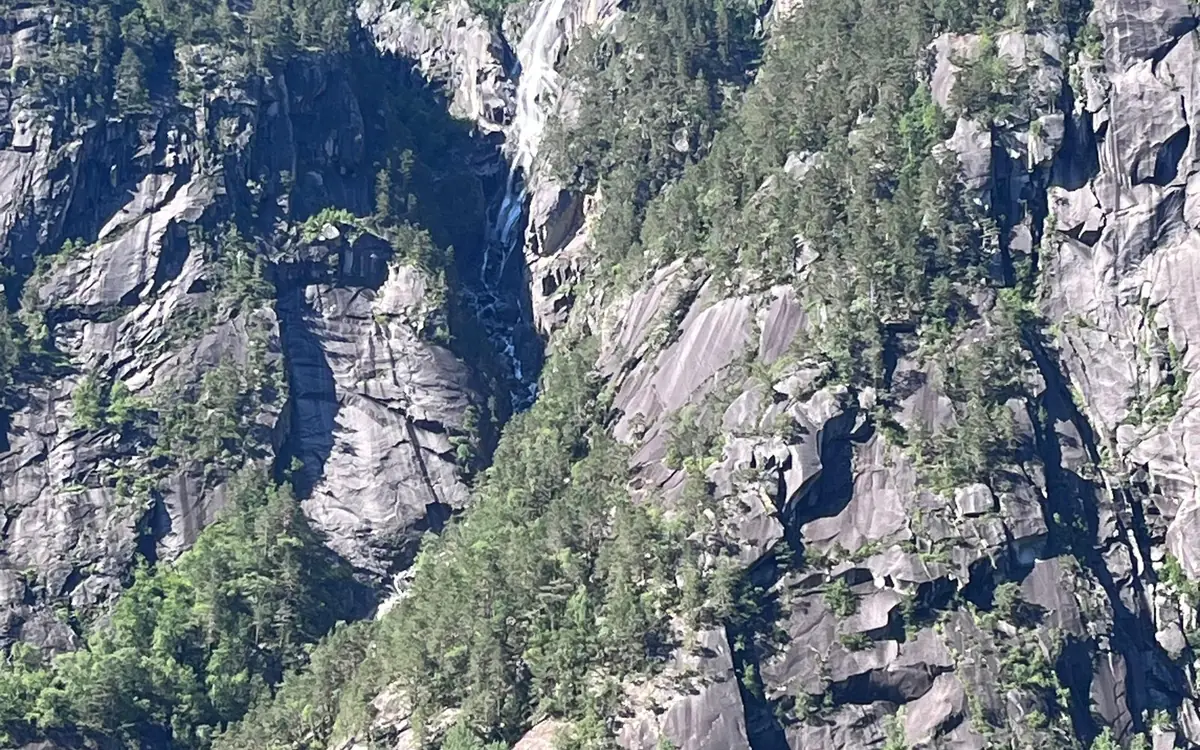
The walls are the thing. They go up several hundred metres almost vertically, with birch growing out of ledges and thin waterfalls coming down them after rain. In still conditions the reflection is complete: the arm doubles, and it becomes genuinely difficult to tell which way is up in a photograph.
Skippers usually stop somewhere in the middle and kill the engine. What you hear then is water on rock and nothing else — no traffic, no other boats, no wind. It lasts a minute or two and it is the part people describe afterwards.
On the way back out the bridge frames the main fjord ahead, and the boat opens the throttle again. The whole thing takes about twenty minutes of a seventy-five-minute trip, and it is what you are paying for.
Photographing a narrow arm
Five things that make the difference
The reflections here are the best photographic opportunity on this fjord.
- Go in the morning
Wind builds through the day. A glassy arm at nine is a rippled one at two.
- Shoot wide, not zoomed
The scale is the subject. A wide frame with the boat in it beats a crop of a rock face.
- Put something in the frame for scale
The bridge, another boat, a person in a red suit. Walls alone read as texture.
- Shoot the reflection square on
Symmetrical frames work here in a way they rarely do elsewhere. Turn the camera and the whole thing reads as an abstract.
- Keep the lens dry
Spray on the way in, spray under the waterfall, and salt dries to a haze that ruins everything after it.
The trip that goes into Fyksesund leaves from Norheimsund, the closest fjord village to Bergen.
Norheimsund→Other narrow arms worth knowing
Five side fjords in the Hardanger system
Fyksesund is the famous one; it is not the only one.
- Osafjorden, from Ulvik
Quiet, steep and reached on the 105-minute safari at $137.
- Simadalen, from Eidfjord
The inner arm under the plateau, with waterfalls and hill farms.
- Sørfjorden
Not narrow, but the orchard arm: forty kilometres of fruit trees on both sides.
- Granvinsfjorden
A short arm towards Granvin, green and rarely visited.
- Eidfjorden
The final stretch of water before the road runs out and the plateau begins.
Common questions
Fyksesund, answered
What is Fyksesund?
A narrow branch of the Hardangerfjord near Norheimsund, a few hundred metres wide, with a suspension bridge across its mouth and steep walls on both sides.
Which boat trips go into it?
The seventy-five-minute RIB safari from Norheimsund at $94 and the one-hour trip from Øystese at $91.
Why is it better than the main fjord?
Scale and stillness. The main fjord is wide enough that the far side is distant scenery; in Fyksesund the walls are on both sides of the boat and the water is flat enough to reflect them.
Can big boats go in?
Not usefully. This is small-boat water, which is the reason to book a RIB rather than take a fjord cruise ship.
When is it at its best?
Morning, before the wind puts chop on the water, and in late spring when the meltwater is still filling the small falls on the walls.
Is there a waterfall?
Several small unnamed ones, and the boats go under one of them on most trips.
Go deeper
More on the Hardangerfjord
Hardangerfjord boat tours
What the trips are, where they leave from and what you see.
The verdictWhich trip is best
Seven trips ranked, and which village to start from.
From BergenFrom Bergen
Two hours by road, and what actually fits into a day.
NorheimsundNorheimsund
The village with the waterfall you can walk behind.
EidfjordEidfjord
The inner end, under the plateau and Vøringsfossen.
UlvikUlvik
A quiet arm of its own, and the longest RIB trip here.
