Waterfalls
Hardangerfjord waterfalls: the famous two and the ones with no name
Above the fjord sits Hardangervidda, the largest mountain plateau in Europe, and everything that melts on it has to come down. Two of the results are on every itinerary; the interesting ones are the falls with no road, no car park and no name, which only a small boat can get you under.
Quick answer
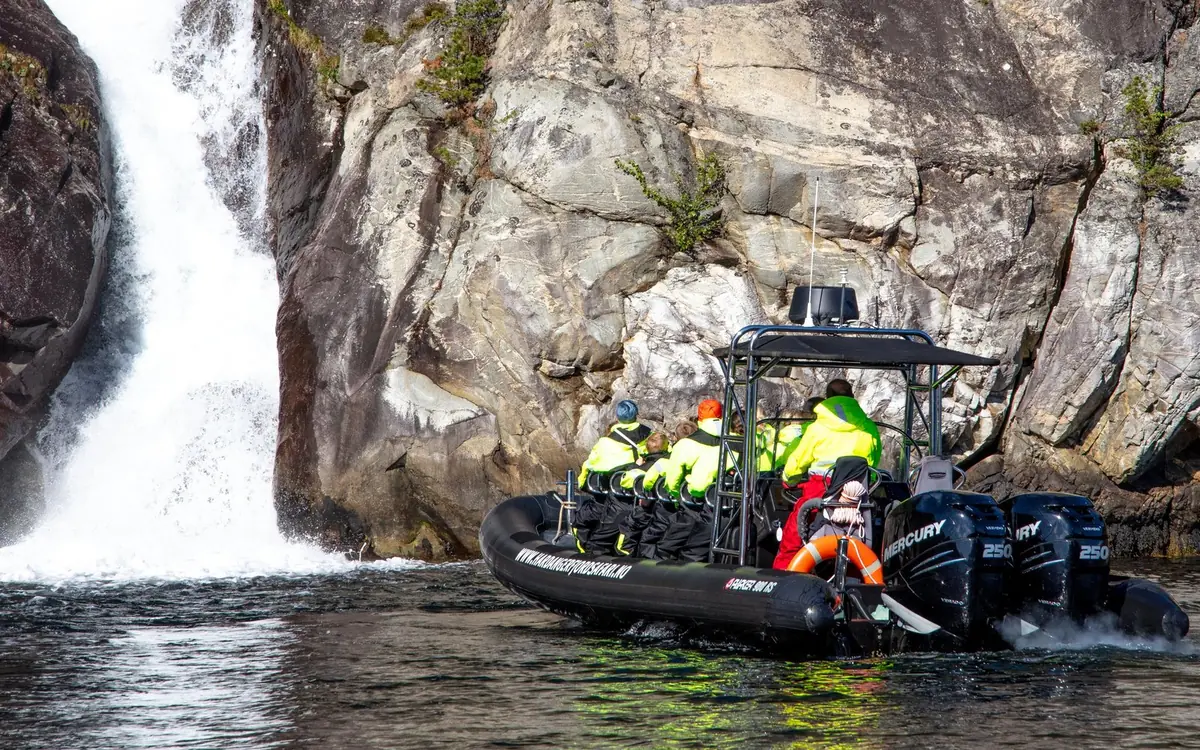
Vøringsfossen near Eidfjord drops about 182 metres and Steinsdalsfossen at Norheimsund has a footpath running behind the water. Both are free and reachable by road. What the boat trips add is the unnamed falls straight into the fjord — the RIB safaris from $81 put the bow underneath one, which is not a figure of speech.
Hardanger waterfalls, at a glance
- Vøringsfossen
- ~182 mnear Eidfjord, off the plateau
- Steinsdalsfossen
- ~50 mat Norheimsund, with a path behind it
- The source
- Hardangerviddalargest mountain plateau in Europe
- Peak flow
- May – Junesnowmelt
- Reachable by road
- Both famous onesand both are free
- From the water
- Unnamed fallsno road, no platform, no name
- The boats
- Go underneathdeliberately, on most trips
- You will get wet
- Yesthe suit helps; the phone needs a bag
- Best light
- Midday in the gorgewhen the sun reaches the bottom
- Cancellation
- Free to 24 hon every boat trip here
The two famous ones
Vøringsfossen and Steinsdalsfossen
One drops 182 metres off a plateau; the other you walk behind. Both are free.
Vøringsfossen falls about 182 metres from the edge of the Hardangervidda plateau into the Måbødalen gorge, twenty minutes by road from Eidfjord. There is a viewing area at the top, a stepped path, and a footbridge across the gorge above the fall that is worth the walk on its own. It is one of the most visited natural sights in Norway and it is free.
Steinsdalsfossen at Norheimsund is smaller — about fifty metres — and more unusual: the water comes over a hard overhang and the softer rock behind has worn back far enough that a path runs along the cliff behind the falling water. Ten minutes to walk round, also free, and a hundred metres from the village.
Both are worth stopping for and both are on the standard route. Neither requires a boat, a ticket or a guide, and both are busy in July.
The ones you can only reach by boat
No road, no name, and the bow goes under them
Falls with no shore and no name, and a boat that puts you inside the spray.
The fjord walls are streaked with falls that never appear in a guidebook. They come off hanging valleys and ledges, drop a few hundred metres in stages, and land in the fjord itself — which means there is no shore to stand on and no road to reach them.
What a RIB does is take you to the base and, on most trips, put the bow into the spray under the fall. The engine drops, the boat noses in, and for ten or fifteen seconds you are inside a very loud cloud of water. Survival suits are provided precisely because of this.
Flow depends entirely on the season. In late May a fall that is a trickle in September is a torrent, and the walls carry a dozen of them where there were three. That is the single best argument for coming in spring.
And because they are unnamed and unphotographed, they are the part of the trip that feels like a discovery rather than an attraction — which is a rare thing on a fjord that has been on the tourist route since the nineteenth century.
Seeing them properly
Five practical notes
Mostly about water, and about protecting a camera from it.
- Come in late May or June
Snowmelt is the difference between a dozen falls on a wall and three.
- Bag the phone before the boat turns in
You will not have time once the skipper commits to the waterfall.
- Put the hood up and turn your back to the spray
Everybody learns this ten seconds too late the first time.
- Wipe the lens with a proper cloth
Fjord spray dries to a haze and a sleeve smears it.
- Do both famous falls by road on the same day
Steinsdalsfossen at Norheimsund and Vøringsfossen at Eidfjord are ninety minutes apart, and both are free.
The trip that puts you under a fall and into the narrow arm is the one from Norheimsund, and it runs all year.
Compare every trip→Five more waterfalls in Hardanger
Beyond the two famous ones
All reachable by road, all free.
- Låtefossen
Two falls side by side near Odda, with the road running across the bridge below them.
- Espelandsfossen
A single narrow drop near Granvin, straight off the road.
- Furebergfossen
Falls into the fjord on the Folgefonna side, with the road passing underneath.
- Skjervsfossen
Between Granvin and Ulvik, with a footpath and a viewing point.
- Tvindefossen
Just outside Voss on the way in from Bergen, and a classic photo stop.
Common questions
Hardanger waterfalls, answered
How tall is Vøringsfossen?
About 182 metres, falling from the edge of the Hardangervidda plateau into the Måbødalen gorge near Eidfjord.
Can you walk behind Steinsdalsfossen?
Yes. A footpath runs along the cliff behind the water at Norheimsund. It takes about ten minutes and it is free.
Do the boat trips go under waterfalls?
Yes, on most RIB trips here. Survival suits are provided and you will still get wet.
When are the waterfalls at their strongest?
Late May and June, when the snowmelt off the plateau is at its peak. By September many of the smaller falls have thinned to streaks.
Are the famous waterfalls free?
Yes, both Vøringsfossen and Steinsdalsfossen are free to visit, though parking may be charged at Vøringsfossen.
Which trip has the best waterfalls?
The Eidfjord RIB, because the inner end of the fjord sits directly under the plateau — but every RIB trip here goes under at least one.
Go deeper
More on the Hardangerfjord
Hardangerfjord boat tours
What the trips are, where they leave from and what you see.
The verdictWhich trip is best
Seven trips ranked, and which village to start from.
From BergenFrom Bergen
Two hours by road, and what actually fits into a day.
NorheimsundNorheimsund
The village with the waterfall you can walk behind.
FyksesundFyksesund
The narrow arm, the bridge and why the boats go in.
EidfjordEidfjord
The inner end, under the plateau and Vøringsfossen.
